
Home > Lenten Blog 2026
“The Fragrance of Jesus’ Love”
March 30, 2026
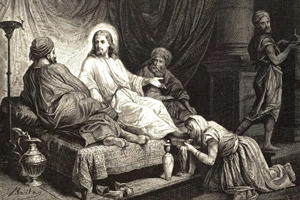
Isaiah 42:1-9 | Hebrews 9:11-15 | John 12:1-11 | Psalm 36:5-11
Mary took a pound of costly perfume made of pure nard, anointed Jesus’ feet, and wiped them with her hair. The house was filled with the fragrance of the perfume. But Judas Iscariot, one of his disciples (the one who was about to betray him), said, “Why was this perfume not sold for three hundred denarii and the money given to the poor?”…
Jesus said, “Leave her alone. She bought it so that she might keep it for the day of my burial. You always have the poor with you, but you do not always have me.”
John 12:1-11
For the past 40 years I have reflected on these puzzling words of Jesus.
And, over these four decades I have served individuals living in material poverty or in the equally imprisoning poverty of the spirit. I’ve been present to share more than a thousand of their personal narratives. And, throughout these years I have never found it possible to believe that Jesus literally meant that these children and people of God are fated to endure poverty’s smothering burdens for endless generations. Instead, I have come to believe that Jesus did not mean for his disciples to tolerate such an intractable fate for their sisters and brothers in Christ.
Why would He expect us to simply provide them food, clothing and shelter generation after generation? Why would He expect us to accept their plight without successfully helping them overcome, in a sustainable way, the circumstances that seem to enable poverty’s power over them and their families?
As I write this, it occurs to me that perhaps the nard John wrote of more than 40 years after the Crucifixion symbolizes the love He has taught us? Might the nard’s fragrance represent the Holy Spirit inspiring and empowering us to bring Jesus’ love to one another as He has loved us? Might Mary represent us all in our sincere and unceasing efforts to feed the hungry, clothe the naked, visit the sick and imprisoned once He has returned to the Father?
As those of us of a certain age may remember, perhaps the War on Poverty that Lyndon Johnson declared, was our country’s sincere secular response to this crisis of poverty. Yet, at that same time, he and a number of historians and sociologists warned that it would not be easily won. They also cautioned that it not be allowed to foster a cycle of generational dependence.
Recently, many Saint Luke’s parishioners attended the film, Traces of the Trade, that my Theology on Tap brothers presented. The film, produced by several descendants of Bristol’s prominent slave trading DeWolfe family, chronicles both their family’s as well as the Episcopal Church’s role in transporting and selling Africans into slavery on the plantations of the Caribbean and American South. It also makes a compelling case for Reparations to redeem the evil that this profit driven trade perpetrated on innocent children of God. And it also spoke of the history of our triennial General Convention’s efforts and resolutions to address this triangular trade and the question of reparations.
Given our country’s six decades of failure to avoid generational dependence despite substantial financial commitments funding our sincere collective efforts, I’ve wondered what might work more effectively? What might succeed in releasing future generations from poverty’s enslavement?
Years of reflection on these puzzling words of Jesus and the Traces of the Trade film as well as Father John’s thoughts on “reading scripture through the lens of Charity” immediately brought to mind some words of Franklyn Cook, my longtime friend, brother in Christ and consultant to hundreds of Rhode Island’s foundations including our own Episcopal Charities. He said that Charity is much more about Time and Talent than Treasure”. Certainly, our feeding ministries involve large commitments of time as well as diverse culinary talents.
Yet for me, these questions also arise. What is the unique talent I can bring to my efforts to follow Jesus’ instructions? Where, in what ways and for whom might I best use them to help future generations release themselves from poverty’s enslavement?
I do not have answers. Not yet. But I’m pretty sure the inspiring work of the Holy Spirit has given me some helpful questions to consider.
Amen.
Mike Cerullo